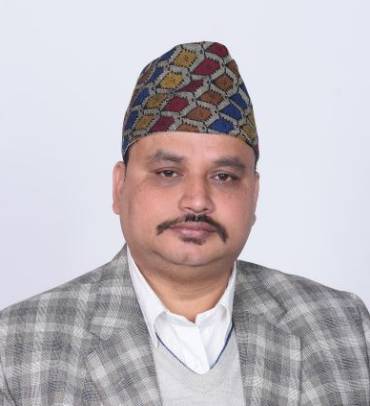
 Dr. Anil Bikram Karki
The 42nd CMAAO President
(2025-2026)
Dr. Anil Bikram Karki
The 42nd CMAAO President
(2025-2026)
Honourable Minister Dr. Sudha Sharma Gautam, Ministry of Health and Population, Government of Nepal;
Respected Chair of Council of CMAAO, Dr. Yeh Woei Chong;
Immediate Past President of CMAAO, Dr. Maria Minerva P. Calimag;
Vice Chair, Secretary General, Treasurer and Council Members of CMAAO;
Presidents and delegates of our National Medical Associations;
Esteemed orator, Dr. Kenza Bennani;
Distinguished guests, colleagues, ladies and gentlemen—
Namaste, and a very good morning.
It is a great honour for me to address you today, in my dual capacity as President of the Confederation of Medical Associations in Asia and Oceania (CMAAO) and President of the Nepal Medical Association (NMA), at the 39th CMAAO General Assembly here in Kathmandu, Nepal.
On behalf of CMAAO and NMA, I extend a warm and respectful welcome to all Presidents, office bearers, delegates, observers and partners present in this hall, as well as those joining us virtually. Your presence reflects a shared recognition that the health and safety of our populations increasingly depend on how well we prepare for, respond to, and manage disasters.
Our Assembly meets under the theme “Disaster preparedness, response, and management” at a time when the frequency and intensity of disasters are clearly increasing across Asia and Oceania. Earthquakes, floods, landslides, cyclones, heatwaves, technological accidents, outbreaks and pandemics have become recurring features of our regional landscape.
These events do not only destroy infrastructure and livelihoods; they disrupt essential health services, overwhelm health systems, and impose immense physical and psychological burdens on our healthcare workforce.
For Nepal, this is a lived reality. We have experienced devastating earthquakes and recurrent floods and landslides. We have seen how quickly health facilities can be damaged, how supply chains can be cut, and how remote communities can be isolated. At the same time, we have also witnessed the courage of health professionals and communities who continue to serve and support one another under extreme conditions.
Today, however, we are not gathered only to recount our challenges. We are gathered to define, together, how we as CMAAO will respond—through a shared framework of principles and actions reflected in the proposed “CMAAO Nepal Declaration on Disaster Preparedness, Response, and Management.”
This Declaration begins by acknowledging the reality we face: that disasters threaten health, lives and livelihoods across our region, and that there is an urgent need for comprehensive preparedness, coordinated response and effective management.
In a concise but meaningful way, it sets out key areas where our National Medical Associations can and must lead.
First, the Declaration calls for us to enhance our understanding of disaster risks—through research, knowledge-sharing and early warning mechanisms. Preparedness begins with knowing our risks clearly: who is vulnerable, what systems are fragile, and where the greatest health impacts will be felt.
Second, it emphasizes governance and leadership. Disaster preparedness must be integrated into health policies, national strategies and medical education, not treated as an occasional project. As National Medical Associations, we have a responsibility to advocate for such integration and to provide professional guidance to our members.
Third, the Declaration underlines the need to invest in resilient and safe health infrastructure—hospitals that can function during crises, reliable logistics and supplies, and technologies that keep essential services running when usual systems fail.
Fourth, it rightly focuses on protecting and training the healthcare workforce. Doctors and other health professionals cannot be expected to respond effectively to disasters if they are not equipped with appropriate training, safety measures and psychosocial support. The wellbeing of our workforce is not a secondary issue; it is central to resilience.
It also highlights the critical role of primary care, often the first and most constant point of contact for communities before, during and after emergencies.
The Declaration further recognizes that, even in crisis, we must ensure continuity of essential services—maternal and child health, immunizations, chronic disease management and mental health care. Disasters do not put these needs on hold, and neither can we.
It calls for rapid response and emergency coordination, for stronger community engagement, and for post-disaster recovery efforts that not only rebuild what was lost, but reduce vulnerabilities and strengthen health systems for the future.
It urges us to harness digital health and innovation—telemedicine, mobile platforms, real-time information systems—to support preparedness, response and continuity of care.
It explicitly acknowledges the often-overlooked burden of disasters on mental health and commits us to integrating psychological first aid and long-term psychosocial support into our disaster responses.
And importantly, it reminds us that health cannot act alone. We must work across sectors—education, infrastructure, agriculture, environment—to build holistic strategies, and we must invest in research, capacity-building and the next generation of professionals, including medical students and young doctors, who will carry this work forward.
Colleagues, this proposed CMAAO Nepal Declaration is more than a list of aspirations. It is intended to be a practical roadmap for our region: a document that can guide advocacy, inform policies and training, and help us hold ourselves accountable as National Medical Associations.
Over the course of this Assembly, through the Taro Takemi Memorial Oration, the Symposium Reports from National Medical Associations, and our deliberations tomorrow, we will refine and, I hope, adopt this Declaration.
Its true value, however, will be determined not by the words we agree to here in Kathmandu, but by the actions we take when we return home—how we use it to influence policies, shape programmes, prepare our members, and build partnerships.
In closing, let me express my sincere gratitude:
- to the Honourable Minister and the Government of Nepal for their support and presence;
- to the CMAAO officers and Secretariat for their work in preparing this Assembly and the Declaration;
- to all National Medical Associations for your reports, contributions and ongoing commitment; and
- to the Nepal Medical Association team and volunteers for their dedicated efforts as hosts.
Disasters will continue to test our systems and our values. But united through CMAAO, guided by shared principles and a common Declaration, we can build health systems that are better prepared, more coordinated, more resilient and more compassionate.
With these words, it is my honour, as President of CMAAO and President of the Nepal Medical Association, to inaugurate the deliberations of the 39th CMAAO General Assembly on “Disaster preparedness, response and management.”
Thank you. Dhanyabad.